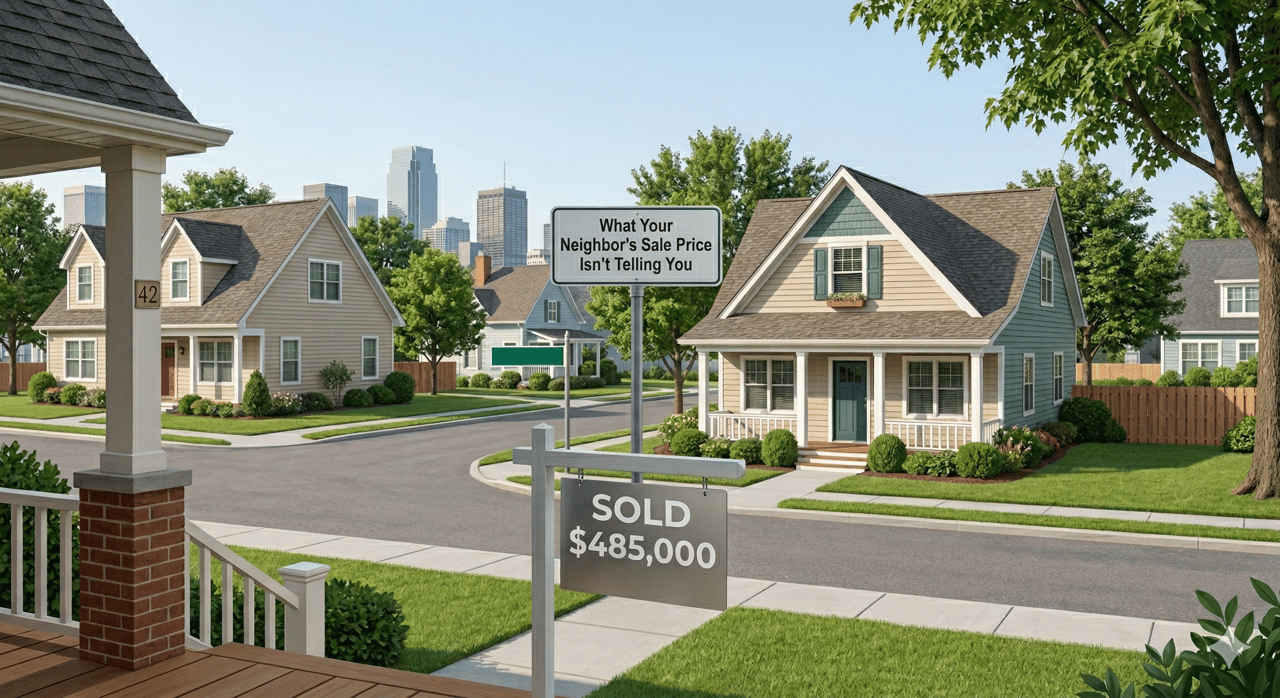
What Your Neighbor's Sale Price Isn't Telling You
Real Estate Mark Daya March 31, 2026
Real Estate Mark Daya March 31, 2026
The five invisible factors behind every transaction — and why the MLS number is just the beginning.
Your neighbor's house sold. You saw the number pop up on Zillow or heard it mentioned at the block party. You filed it away. You think you know what your house is worth — or what you should offer on the one you're looking at.
But that sale price is a headline, not a story. And the story is where all the important information lives.
Here are five things that the sale price will never tell you on its own.
1. How Long It Sat Before It Sold
Days on market is one of the most important signals in any transaction. A home that sold after 90 days at $480,000 is a fundamentally different data point than a home that sold in 6 days at the same price. The first sale likely involved price reductions, stale listing energy, and a seller who conceded on terms. The second represents true market demand at that number.
Using them as equivalent comps leads to real mispricing — either leaving money on the table as a seller, or overpaying as a buyer.
2. What Concessions Were Made
In many transactions — especially in markets where buyers have more negotiating room — sellers agree to cover closing costs, pay down points on the buyer's loan, or credit repairs. These concessions can amount to $5,000, $10,000, or more.
They don't show up in the sale price. They show up in the net proceeds the seller actually received. If your neighbor's $475,000 sale included $12,000 in seller concessions, the true economic value of that transaction was closer to $463,000. That matters when you're setting a listing price.
3. The Condition the Home Was Actually In
No MLS record captures whether the kitchen was renovated last year or whether the HVAC was 22 years old. No public record tells you whether the roof was recently replaced or whether there was a foundation repair in the disclosure documents.
Condition is invisible in sale prices — but it is completely embedded in them. Two homes that look identical on paper can have $40,000 worth of condition difference underneath the number.
4. The Buyer's Financing Type
Cash buyers often move faster and accept more risk, which sometimes means paying a premium — or sometimes means getting a discount because sellers value certainty over price. VA loans have specific appraisal requirements. FHA loans have condition thresholds. Conventional financing sits somewhere in between.
The financing structure of a sale affects what price was achievable and under what conditions. It's invisible in the public record and completely relevant to what your home should be priced at or what you should offer.
5. What Was Negotiated After Inspection
Almost every transaction has a renegotiation point after inspection. Credits, repairs, price reductions — these adjustments happen quietly and don't change what the public sees as the final sale price.
A home listed at $490,000, under contract at $488,000, and then credited $8,000 post-inspection for electrical work effectively sold for $480,000. The MLS says $488,000. The story says something different.
What This Means for You
Whether you're a seller trying to price your home right or a buyer trying to make a smart offer, you need someone who reads these transactions the way an experienced investor reads a financial statement — not just the headline number, but the full context.
That context is what separates pricing that works from pricing that sits. It's what separates confident offers from ones that fall apart.
We read these transactions every day. Let us read yours.
Stay up to date on the latest real estate trends.

Real Estate

Real Estate

Real Estate

Real Estate

Real Estate